
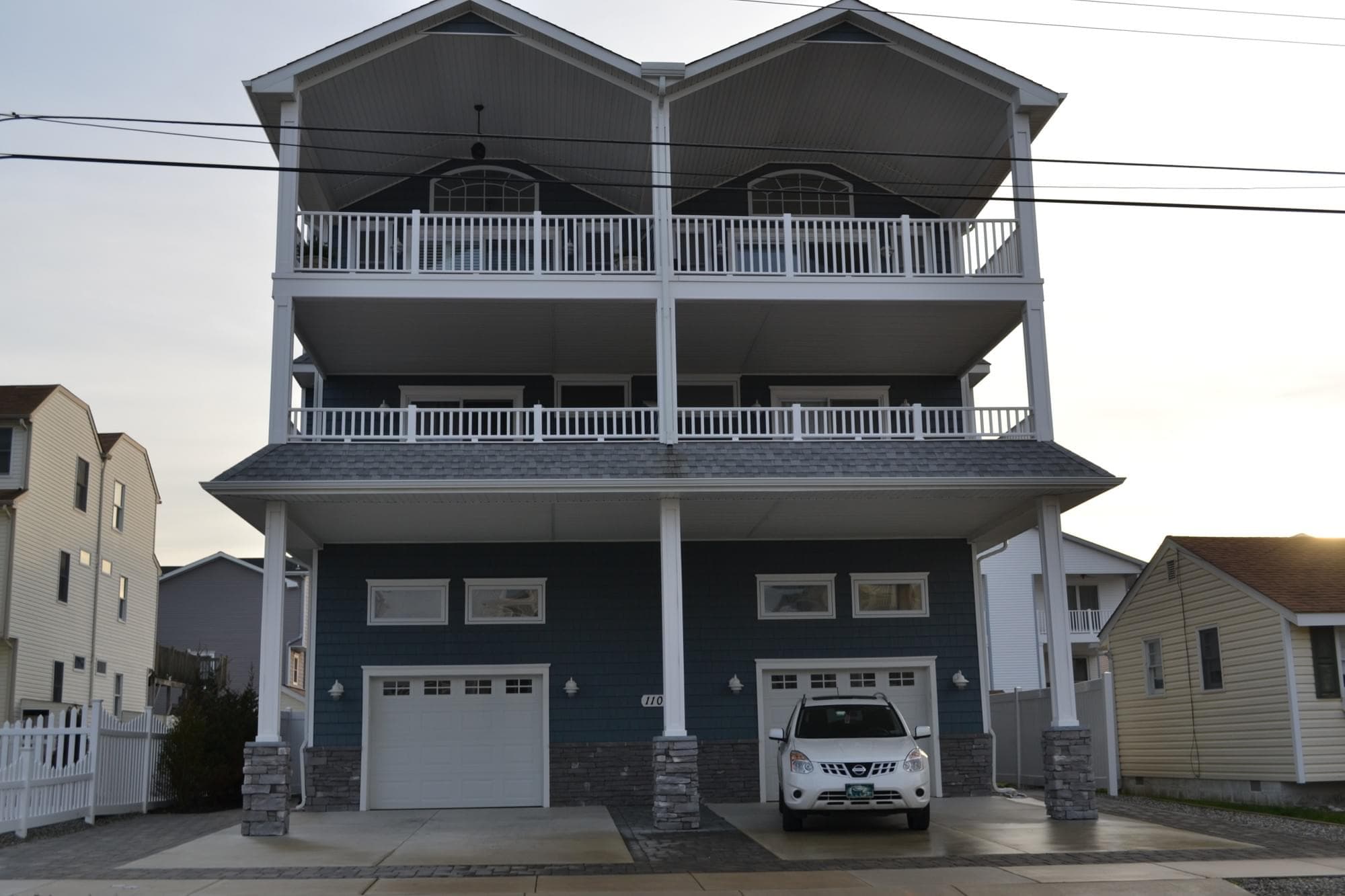
The question lands in my inbox pretty regularly, usually from someone who just ran the rental numbers and got excited.
You've got a single-family cottage — call it a 1,050-square-foot, 1950s-era place on a mid-block lot in Sea Isle, maybe three blocks off the beach, one full bath, the kind of house that rents as a weekly for somewhere in the high $2,000s peak season. And then somebody tells you that the duplex two doors down rented both units last summer and cleared nearly double that. So you start wondering: what would it actually take to split this thing?
The short answer is: it depends almost entirely on your zoning district, and the answer is more often "no" than owners expect.
What the Zoning Actually Says (and Why It's Not a Formality)
Sea Isle City, like most Cape May County shore towns, has residential zoning that distinguishes between single-family and two-family uses at the ordinance level. If your lot is in an R-1 or equivalent single-family district, a duplex is not a permitted use. Period. You can't get there through a variance in most cases — use variances for two-family in a single-family zone require a "D variance," which means a higher legal burden, a planning board hearing, and, frankly, a low probability of approval unless you've got a compelling case that goes beyond "I want more rent."
Some blocks in Sea Isle are zoned for two-family use. Some aren't. I've seen identical-looking streets two blocks apart where one is R-2 and one is R-1, and it matters more than the architecture does.
So step one — before anything else — is pulling the actual zoning map for your parcel. Not assuming. Not asking a neighbor. Pulling the map, reading the ordinance, and if you're serious, talking to the zoning officer directly. This isn't something you want to find out after you've paid an architect.
The lot dimensions matter too. Two-family construction typically triggers higher minimum lot area requirements, setback recalculations, and parking minimums. A 3,750-square-foot lot that comfortably holds a single-family cottage might technically be undersized for a by-right duplex even if the zone permits it.
The Income Delta Is Real — and That's Part of the Problem
Here's where I'll contradict myself a little. I've been spending the last few paragraphs tempering expectations on zoning, and that's all true. But I also don't want to undersell the financial logic that's driving the question in the first place, because it's not irrational.
A well-configured duplex in Sea Isle — two units, each sleeping 8 to 10, properly licensed and marketed — can generate gross seasonal rental income that's meaningfully higher than a comparable single-family house. The spread varies by block, condition, and how the units are set up. But owners in that range tend to ask about conversion for a reason. The math does look different on the two-family side.
The issue is that getting from "single-family cottage" to "legal duplex" is not a renovation project. It's a redevelopment decision. You're typically looking at either a substantial gut renovation that restructures the floor plan, adds a separate entrance, separates utilities, and meets current code — or you're tearing down and building new.
(And building new in a flood zone, which most of these properties are, introduces a whole separate layer of cost and regulatory complexity that the rental income math doesn't automatically account for.)
If you're in an AE zone versus a VE zone, your base flood elevation requirements, your freeboard requirements, and your insurance costs look different. I've written separately about what those flood zone designations actually cost you in Sea Isle City and about the building and insurance implications in Avalon and Stone Harbor — worth reading before you price out construction.
A gut conversion on a 1950s cottage isn't cheap under any scenario. You're touching electrical, plumbing, HVAC, potentially the structure itself. If the existing foundation isn't sufficient for the new use classification, you may be looking at foundation work too. The numbers can get to a place where a teardown-and-rebuild pencils out better than the conversion — which is a conclusion that surprises people when they first hear it, but it comes up a lot.
When a Conversion Makes Sense vs. When It Doesn't
If the zoning is right — meaning your parcel is already in a two-family district — and the lot dimensions work, and you have a structure that's in decent condition and sits at or close to current BFE requirements, a conversion feasibility study is worth commissioning. That means getting a local architect and a contractor to walk the property together and give you a real number, not a back-of-envelope guess.
If any one of those conditions isn't met, the calculus shifts fast.
Owners who come to this question from an inherited property — or from a property they've held a long time and are starting to think about the next chapter of — sometimes find that the more productive conversation isn't "how do I add a unit" but "what does a developer see when they look at this lot." Those are different questions with different answers.
I've covered the joint venture angle in a few places for owners who want to participate in upside without doing a full sale — how a shore joint venture actually works and when a joint venture makes more sense than an outright sale both walk through the structure in more detail. For inherited properties specifically, there's a path that avoids the MLS entirely and the carrying costs that come with it — selling an inherited shore home without listing it gets into that.
The reason I bring these up isn't to steer away from the conversion question. It's because owners sometimes assume conversion is the only way to capture development value, and it isn't.
One more thing worth saying plainly: the gap between what a property lists for as a single-family home versus what a developer will pay for the same lot is often substantial. That spread is documented pretty clearly and it changes the decision tree.
If you're specifically in Avalon or Stone Harbor and wondering what a developer would actually pay for your lot as-is, I've written about that too — Avalon lot value to a developer in 2026 and Stone Harbor lot value both give frameworks for thinking through that number without just guessing.
---
What I keep coming back to is the owner who sits on an R-1 lot, runs the duplex income math, gets excited, calls a contractor for a ballpark, and then — six weeks later — finds out the zoning doesn't permit it. That's a conversation that should have happened first, not after the contractor visit. The zoning map is free. The zoning officer's number is on the municipal website.
You'd be surprised how often the lot next door is in a different zone entirely.
---
If you're working through the conversion question on a shore property — or trying to understand what your options actually are — reach out to Redfern Ocean Development. We work through this kind of feasibility analysis regularly and can usually tell you in one conversation whether conversion is on the table or whether there's a better path worth looking at.