
The question I get more than almost any other from owners sitting on an older Sea Isle property — the ones who've been renting it out for twenty years and think they're doing fine — is some version of: is what I'm making actually good?
Short answer. Usually not.
And I say that as someone who spent a long time watching the shore rental market from the inside, not as an outside analyst with a spreadsheet. The gap between what an old single-family in Sea Isle City earns and what a well-built modern duplex on that same lot earns is not marginal. It's not a rounding error. It's the difference between a yield that barely covers carrying costs and one that actually performs.
What the Old Single Family Is Actually Pulling
Take a typical 1960s single-family on a 30x100 lot in Sea Isle — three bedrooms, one bath and a half, no elevator, hasn't been substantially updated since the early 2000s. Maybe it sits two blocks from the beach. It's not a teardown in anyone's mind yet. The family rents it seasonally, usually to the same returning renters who've been coming for fifteen years. Comfortable. Known quantity.
That house is probably generating somewhere in the $25,000 to $40,000 range gross for the season. If it's closer to the water and the owners have kept rates up with the market, maybe it pushes toward $40K. If they haven't — and a lot of longtime owners haven't, because the same renters come back and there's an unspoken agreement not to raise rates dramatically — it could be sitting at $28K or $30K and hasn't moved much in years.
Subtract property taxes, insurance (which in Sea Isle is not cheap, especially once you're in the AE or VE zone — that distinction matters more than most people realize), maintenance, and any management fees, and the net gets thin fast.
That's not a bad outcome for a family that paid $180,000 for the property in 1989. It's a rough outcome for someone who's thinking about it as an investment asset at today's valuations.
What a Modern Duplex on That Same Lot Earns
Here's where the math gets interesting.
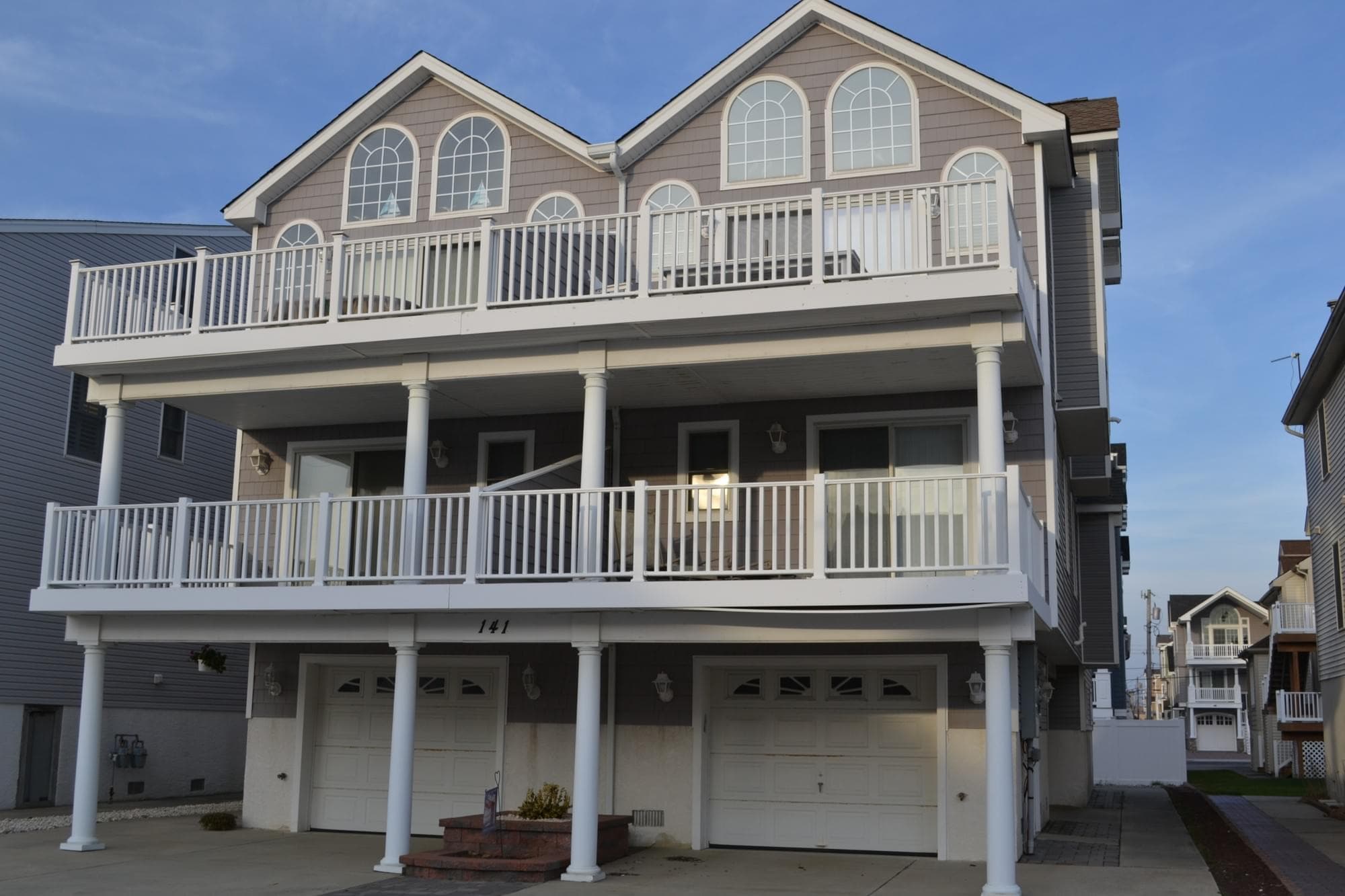
A new construction duplex on a similar Sea Isle lot — two units, each three bedrooms, two baths, elevator, rooftop deck, designed specifically for the rental market — is not an unusual thing to see pulling $35,000 to $45,000 per unit per season. Sometimes more if the location is right and the fit-out is sharp. Sometimes less if the owners priced conservatively or didn't market aggressively.
Combined, that's in the $70,000 to $90,000 gross range. Per year.
(That's not a projection or a best-case scenario — it's a bracket I've watched actual Sea Isle duplexes land in repeatedly, across different blocks, different owner situations.)
Against the $25,000 to $40,000 from the old single, that's a meaningful difference. On the same footprint. The lot didn't change. The block didn't change. What changed was what was built on it.
Now I'll contradict myself slightly here, because fairness requires it: not every old single-family is underperforming, and not every new duplex automatically lands in that top bracket. There are well-maintained, well-located Sea Isle singles that earn solidly. And there are new duplexes that owners have struggled to rent because they priced wrong or the interior finish didn't match the rate they were asking. The math works on average. It doesn't work automatically.
Why This Changes the Conversation — for Sellers and Buyers Both
For owners of that old single, the rental income comparison is one part of why the conversation about redevelopment or sale starts to open up. The other part is what the lot is actually worth to a builder versus what the house is worth on the retail market. Those two numbers are not the same, and the spread between them is where decisions get made. The quiet cost of listing an aged shore home on the MLS is real — and it's not just commission.
For buyers or investors thinking about Sea Isle, the duplex math is the core of the yield story. Shore real estate carries high acquisition costs and high carrying costs. The only way the numbers work at scale is if the income is there. A single-family at $30K gross in a market where a comparable duplex pulls $80K isn't a conservative investment — it's just a lower-returning one.
Owners in the block range from 40th to 60th Street tend to ask whether their specific location supports duplex rents at the high end of that range. The answer depends on proximity to the beach, parking, and zoning — not all Sea Isle lots permit duplex construction, which is worth understanding before any other conversation starts. The zoning picture is more nuanced than people assume.
There's also the question of what happens if you can't tear down and build new — if the existing structure's condition or FEMA's substantial improvement rules put a ceiling on what renovation can accomplish. That rule kills renovation math more often than people expect, and it's worth knowing whether you're in that category before you spend money finding out.
For owners who want to participate in the upside without selling outright, there's a structure for that too. How a joint venture actually works — the splits typically run 25% to 50% of net profit structured per deal, and the timeline from demolition to sale-ready runs approximately 6 months — is a different conversation than a straight sale, but it's one that comes up a lot with families who want to stay in the outcome.
We can close in as little as 10 days or on your timeline. Neither of those things requires the house to be listed anywhere.
---
What I keep coming back to is a pattern: an owner who's been renting the same three-bedroom in Sea Isle for years, proud of never having a vacancy, not realizing that the lot under that house is sitting on a meaningful yield gap every year.
Is that gap real for your property?
Submit your property to Redfern Ocean Development for a no-obligation evaluation →